
Watch cost per wear
Cost per wear is what you paid for a watch divided by the days you wore it. A $450 watch worn 96 times has cost you $4.69 a wear, and every wear after that brings it down.
By Raja, maker of Wristkeeper. Updated 3 November 2026.
Work it out by hand
cost per wear = price paid ÷ days worn
- Write down what you paid. The price you paid, not the list price. A grey market deal or a gift card changes the answer.
- Count the days it was on your wrist. Your calendar, your camera roll and your memory of trips all help.
- Divide. $450 over 96 days is $4.69 a wear. Wear it 4 more times and it drops to $4.50.
Step 2 is where it goes wrong. Few collectors know how often they wore a watch last year, so the count is a guess, and the guess flatters the watches that sit in the box.
Keep a wear log in a spreadsheet
A log turns the guess into a count. It takes 1 row a day.
- Make 2 sheets and name the second one Log. On the first, list each watch in column A and what you paid in column B.
- On Log, add a row every day you wear a watch: the date in column A, the watch's name in column B.
- Back on the first sheet, count the wears in column C with
=COUNTIF(Log!B:B, A2). - Work out cost per wear in column D with
=IF(C2=0,"",B2/C2), which stays blank until the watch is worn.
It works as long as you open the sheet every morning. Miss a week and the numbers drift.
Track it on your iPhone with Wristkeeper
I own more than 30 watches and kept wearing the same 3, so I built Wristkeeper to keep the count for me. It's an iPhone app for watch collectors. Each morning it suggests 1 watch from your box, and a hold logs the wear.
- Add a watch. A photo, a name and the price you paid.
- Hold once to log today's wear. Forgot yesterday? Add any past day.
- Open the watch. Its page shows the wears, the wears this month and the cost per wear against the price you paid.
- Read the month. When a month ends, the Wrist Report shows your most worn watch, your rotation and what each one cost per wear.
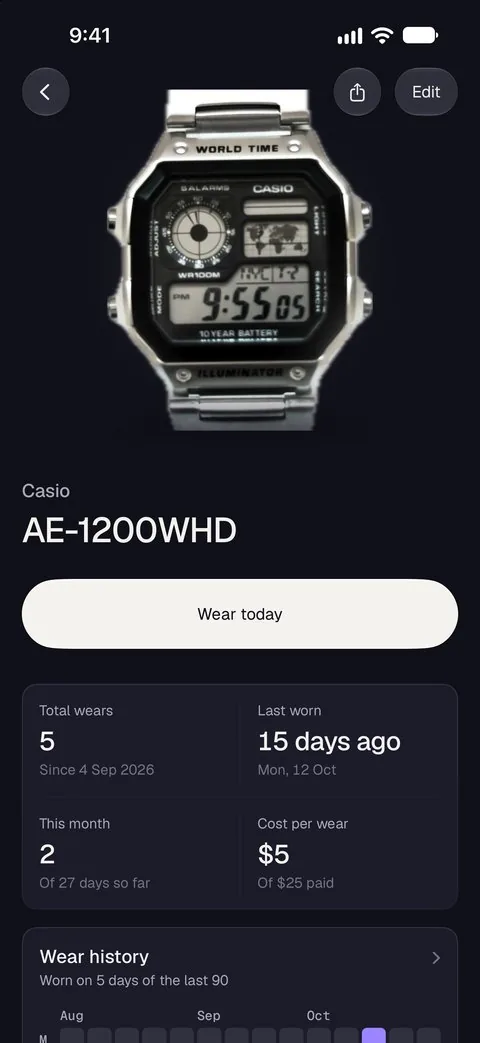
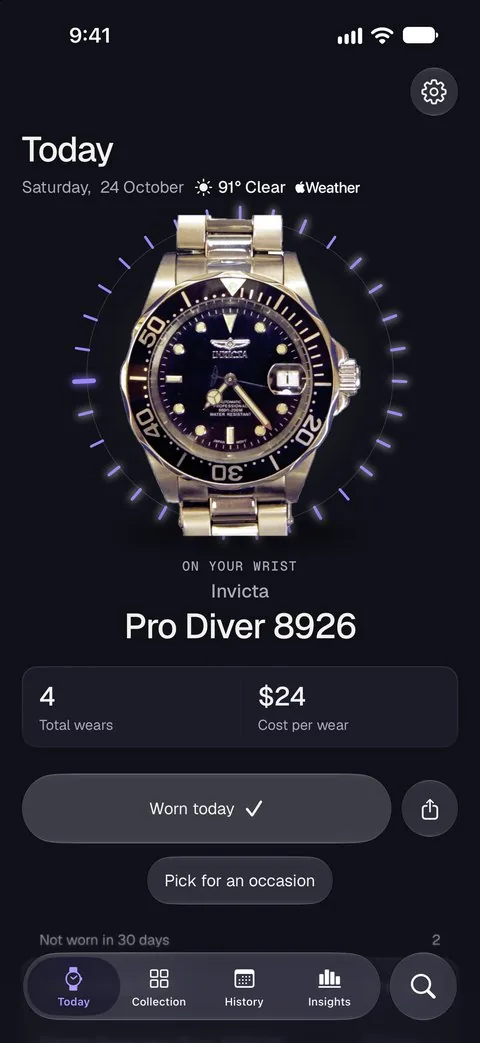

Free for up to 3 watches, forever. Pro covers your whole box for $24.99 a year with 14 days free, $3.99 a month, or $59.99 once. Your watches and wears stay on your iPhone and in your own iCloud, with no account and no ads.
Wristkeeper is out on the App Store on 17 November 2026. The beta is open now, with Pro free while you test.
Questions
Should cost per wear include servicing and resale value?
It can. Add what you spent on servicing and straps, take off what you could sell the watch for, then divide by days worn. The simple version, price divided by wears, is easier to keep up and is what Wristkeeper shows.
What is a good cost per wear for a watch?
There is no fixed number. The useful comparison is inside your own box: the watch with the highest cost per wear is the one waiting longest for a day on your wrist.
Can I add wears from before I started tracking?
Yes. In Wristkeeper you can add any past day, so a watch you've owned for years starts with the wears you remember.
Can I bring my list over from another app?
Not yet. Adding a watch takes a photo, a name and a price. More answers are on the Wristkeeper support page, and screens and prices are in the press kit.